

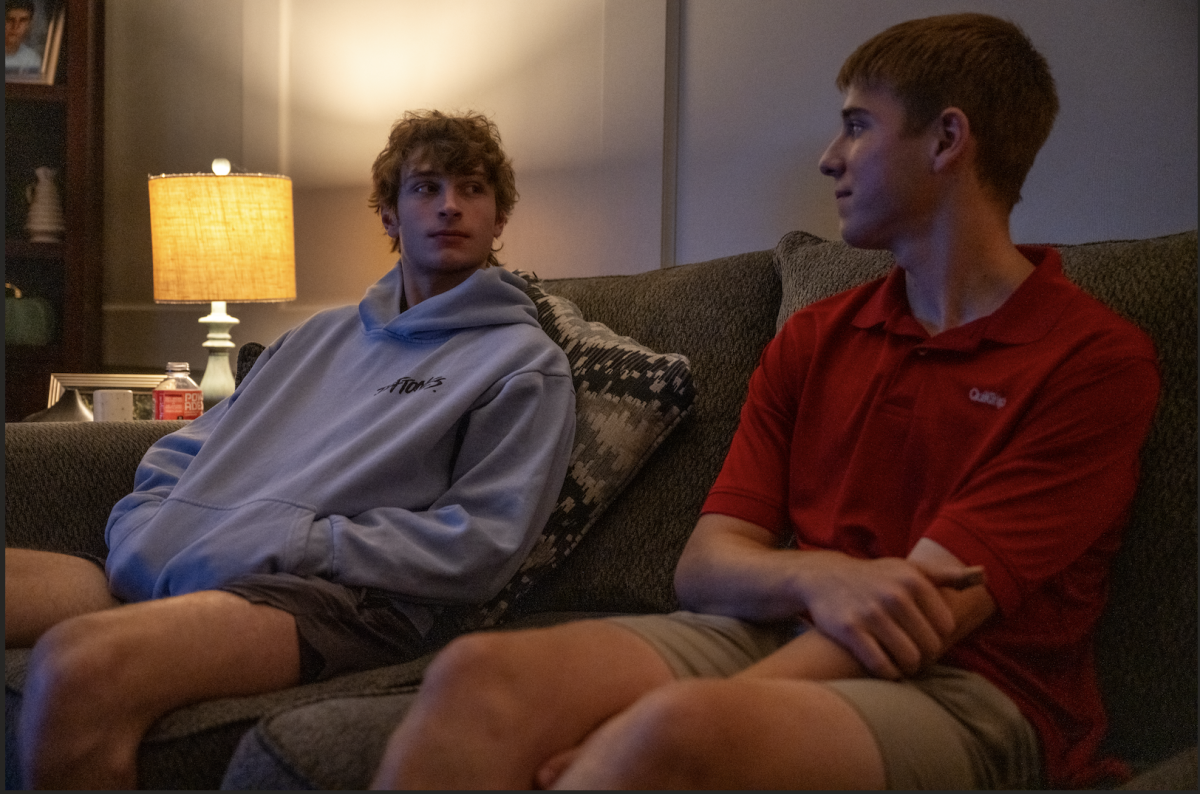


















![Juniors Tad Lambert and Lily Reiff watch swim footage Jan. 19 in Room 153. Lambert and Reiff were editing their swim recap for Cougar Roundup. “[KUGR] is such a great environment for creativity but also to form amazing friends,” Lambert said. “KUGR has become like a home for me and I feel like I’ve gotten super close with so many other members.”](https://smnw.com/wp-content/uploads/2023/01/ejohnson_KUGR_7-900x600.jpg)


Timidly, I press her cold knuckles to my forehead.
She’s another entry in the long list of titas and titos I’ve compiled over the years, people that my parents know through relation, or mutual friends, or the mysterious method through which all Filipinos in KC seem to be connected.
I know enough to bless, to make mano. I’d been guided through it since I could remember.
Standing idly by as my parents and the other Filipino conversed, their dialogue no more than white noise to me, I waited for my prompt to perform the gesture, taking the adult’s offered hand and touching it to my forehead. I’m in elementary now and, across my wide span of Filipino parties and events, have nailed the routine.
But I don’t know enough to understand what she says to me, happy mouth, squinting eyes, as her hand retracts.
Without words to respond, my smile is polite but insufficient.
My mom’s voice arises from behind me like clockwork. I catch the word “Tagalog” within the following stream of actual Tagalog. Explaining that I don’t know it. I infer this much easily.
I’m not old enough to care. Just old enough to feel shy under tita’s gaze as I wait for my involvement in the interaction to be over.
It takes until I’m working age to really feel it.
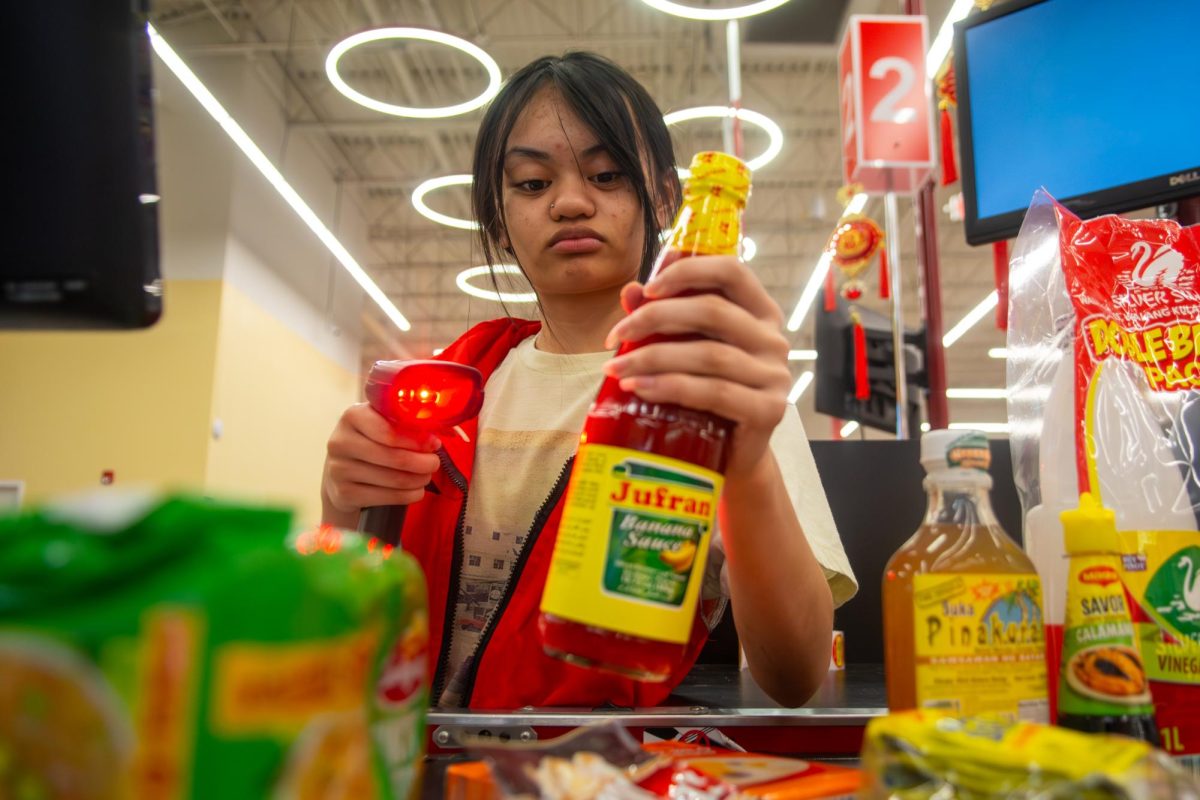
Feet and back aching slightly, hands dry from wet, frozen product, red Pan-Asia vest shrugged over a hand-me-down (courtesy of my father), pale yellow shirt with a graphic of a polaroid taken in Manila. The vest, according to the tag, is a size M, yet it fits me fine when I’d usually need an XS. I assume this is because it’s from an Asian manufacturer. I’m freshly 17 and sliding groceries into bags.
Scan, bag, scan, bag. I habitually prompt the shoddy conveyor belt’s motion sensors to bring items forth. Mechanically recite, your receipt will print right here! Have a good day! Grow numb to the song that echoes along the store’s vast aisles, I swear, at least once every shift.
It’s only upon hearing the familiar punching rhythm of Filipino that I wake briefly from my cashier hypnosis.
Families bickering and directing children to unload their cart onto the conveyor belt, or joking amongst themselves and laughing in that loud way Filipinos do.
I feel a strange sense of longing, of misplaced excitement, as I grab their all-too-familiar groceries – Pinakurat vinegar, Jufran banana ketchup, Knorr liquid seasoning. I want to say something. I want to tell them, “we have these too, my dad loves banana ketchup.” I want them to recognize that we’re the same.
Then they speak, and it’s Tagalog, Bisaya, whatever Filipino dialect it might be – and the words don’t come. It feels a little like wanting to eat at the grown-up table. And I give them the same recitation – your receipt will print right here.
At home, when my parents ask, ever curious about my day-to-day at the largest Asian grocery store in the metro, I tell them I check a lot of Filipinos out. I tell them how I recognize what they buy, how sometimes they know my parents by name, and how sometimes they ask me first: “Are you pinoy?”
When my parents’ curiosity branches into why I even want to keep working at Pan-Asia – it’s 20 minutes away on the highway, I could easily work closer, and they’d never badgered me to pay for myself or get a job – I avoid answering.
For whatever reason, telling them that I like the opportunity to be surrounded constantly by Asian words and food feels insensitive when, in theory, I have that opportunity at home. It’s just that they don’t speak Filipino to me.
Of course, it’s not without reason. They chose not to teach me, worrying about me achieving proficiency in English otherwise. So it was to make my assimilation easier.
I imagine their journey here: however many painstaking years of education and nursing school, their professions decided for them because that’s how you get to the US.
My mental illustration of their past is lined with the lush foliage encompassing Google Images’ results for ‘Philippines landscape’; washed over by the beaches I infer they grew up with when they tell me stories of fish caught in lunchboxes and drive 11 hours to wade into the ocean off Texas’ coast; warmed by the oppressive heat and humidity that causes my dad to scoff – “if you think this is bad, you would not be able to stand the Philippines” – at Kansas’ 100º highs.
I have no experience with any of it. The image is foreign to me.
I’d tried to bridge the gap before. Duolingo didn’t have Tagalog, so I’d resolved to Rosetta Stone to teach me. It must have been around three or four times, only one of those taking place in my double-digit years of age.
Sitting in the quiet under my Frozen comforter, I recited into my iPhone 6s, batang babae, batang lalaki, for Rosetta herself to grade my pronunciation — green check for ‘young girl,’ green check for ‘young boy.’
None of my attempts stuck longer than a couple days or weeks, maybe out of a failing of will or attention span. So I was partially to blame for that gap.
When I was little, I’d ask how to say random words in Tagalog – bathtub, flag, painting. Really, I’d just wanted to learn more about this fantastical Filipino culture I’d watched around me and been told I was a part of. And even now, playing songs in the car and asking my dad to translate line-by-line – I don’t get the satisfaction I want. Because I feel, still, like an outside observer.
I realize there is no cure for this. In every aspect that births the fabled “true” Filipino identity I’d desired, I’ve lived an American life. I DoorDash Cane’s after my mom’s sinigang soup. I read of political instability and corruption in the motherland on my uncased, scratched up iPhone 16. I’ve lived happily – enjoyed my lifetime access to convenience; to the free pursuit of a career that interests me; to the kind of economic freedom that lets me spend money recklessly that my parents have built up to over the course of their lives.
Yet knowing this doesn’t stop the irrational shame when my cousins (who probably aren’t actually my cousins, just Filipino) banter back-and-forth with the adults, and I sit silently, balancing full paper plate on pressed-together thighs. Or when my friends, also children of immigrants, talk of understanding but not speaking their parents’ languages, and I think childishly to myself – at least you can understand.
I see those bickering families, and it feels like looking at what could have been.
What do you do with the shame of having lived comfortably? How do you reconcile the crack that forms when you know you belong in part to this privileged, American life, yet still long, irrationally, ungratefully, to be closer to that mythical other half?
You scan the groceries. Listen to that same song. And you wait to spot banana ketchup.