



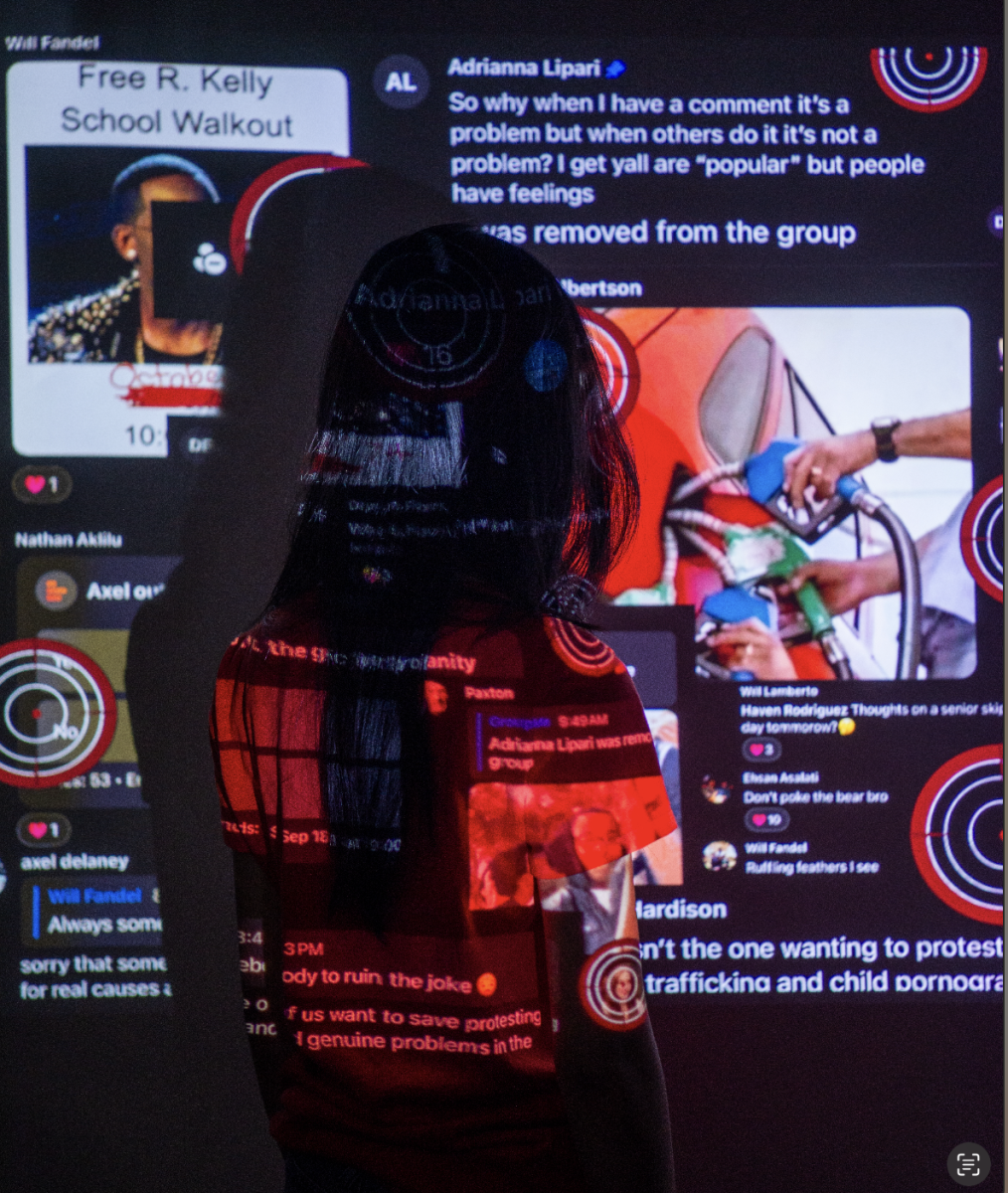































Are you Blind-Folded?
Students who have used their devices all day, have to now alter their routines, making it so that “phone time” is at inconvenient times
The phone ban doesn’t just affect cheating on assignments or minimizing distractions in class, it’s also affecting students who keep to themselves. Sophomore Noah Phillips says that he’s seen students at lunch sitting by themselves, staring into space.
“What ended up happening is people who were on their phone sitting alone at lunch, seem even more sad and lonely than they were before,” Phillps says.
Those thirty minutes at the lunch table are some students’ time to relax, and put their life that’s constantly going for seven hours, on pause. If they don’t have someone to talk to, it tends to be students’ first instinct is to grab their phone. It’s something they’ll always have, it’s comforting.
Now that safety net is gone, and they have to get out of their shell.
“Before the ban I didn’t get on my phone that much outside of lunch and passing period. I would play games on my phone when I was done with an assignment in class, but now you can just play them on a MacBook,” Phillips says.
If you walk into a class and pay attention to the computer screens, the majority of them many have unblocked games or YouTube. With the ban, students keep putting in effort to go around it, and find ways to continuously entertain themselves.
“It is so easy to get them, despite all the districts’ efforts. There is some crazy tech that you can use to unblock stuff on your MacBooks and more people are doing it now than ever,” Phillips says. “Anyone who was distracted on their phone before is just distracted on their MacBook.”
Students who do abide by the new restrictions go the entire school day without checking their device.
“They wait all day without checking their phone, to get out of school and go to the parking lot. They go into their car and continue checking their phones. When they’re leaving the school parking lot, they’re still checking their phone,” Phillps said.“Last year the parking lot was already like a war zone. Now it’s even worse. Now it’s a war zone, but everyone’s blindfolded.”
Story by: Hope Hunt
“Are we Going to get Caught?”
Students are finding new ways to be on their devices despite phone ban
*Students names have been changed*
Senior Jennie Walton* walks into the bathroom during passing period and sees about six girls on their phones. Some are up against the wall texting, others are taking group selfies in the mirrors. They only have five minutes to check all their notifications, and decompress on their device, while still trying to get to class in time, but everyone feels the anxiety that a teacher will walk in.
Though there’s a state-wide phone ban in schools, students are still finding loop-holes, ignoring the risk of getting their device confiscated.
“It’s getting to be a problem where every time I go to the bathroom, everyone’s just using their phone. They’re not even using the bathroom,” Walton* says.
Passing period isn’t the only thing that’s changed. Communicating with friends has been altered as well. Students are now resorting to emailing or having a shared Google Document to communicate with each other. When the lessons become dull, Walton* makes an E-Hall pass to the bathroom. She grabs her phone from her bag and texts her friends to meet up in the halls for a break. Grabbing her phone just seems easier to communicate rather than pulling out her MacBook.
“Some friends that I don’t have classes with I have to text, but teachers are still going to take my phone for that.”
With it being her senior year, documenting little moments in class or at lunch feels very important. She wants to make sure she remembers the year.
“It’s the social aspect of it. What if I want to make a cute TikTok with my friends? I feel like making memories and keeping them, now it’s something I can’t do anymore,” Walton says.
Students have resorted to digital cameras now. At Senior Sunrise, the majority of students were taking pictures with their friends on their cameras. Even Spirit Club is using their digital cameras to take pictures of teachers and students in their Adam Sandeler fits during the first week of spirit days this year, for Instagram.
Walton feels as if it’s a lot harder to document the moment.
“I don’t want to get my camera out, I’ll get my phone instead. It’s quicker.”
Walton has seemed to notice that the ban has students spending more time figuring out how to hide their device, rather than just existing at school.
“People are gonna still be on their phone,” Walton* said. “Now it’s just, are we going to get caught or not?”
Story by: Hope Hunt
We Didn’t Create the Problem
Junior Rachel Pierce highlights the hypocritical aspects of the phone ban created by older generations
The Gen Z and Alpha generations were raised in a world where technology was continuously pushed on them.
Now the same generations that created the technology are blaming the younger generations for being attached to the addictive algorithms they programmed.
Junior Rachel Pierce is not highly affected by the phone ban but finds adults’ obsession with Gen-Z’s use of technology rather hypocritical.
“It’s like you created it. You push us on it, and then now you’re taking it away, and then blaming us when we rebel against it,” Pierce says.
She recognizes the problems phones have caused in schools including decreased attention span and negative mental health repercussions, but doesn’t believe the full ban was very necessary.
“Even when we didn’t have the phone ban, I feel like when I was at school, I wasn’t on it a bunch anyways,” Pierce says.
Members of the Generations X, Millennials, and baby boomers created the ban in schools with the intention of helping Gen Z and Alpha learn. Pierce thinks there are likely deep reasons students don’t want to learn.
“I don’t think our phones are the reason why we don’t want to learn. I’m not on my phone, and I still don’t want to learn in your class,” she says.
Older generations have created an all or nothing mindset around technology. Putting all the attention on phones may not be the only answer to the problem older generations were trying to solve with the phone ban.
Story by: Claire Rogers
Positive Change
Junior Jo Ridgway describes the positive changes the phone ban has brought into her life
The phone ban was put in place to improve social interaction and limit distraction in the classroom.
Junior Jo Ridgway has found the ban overall to be doing just that.
Over the years Ridgway has struggled to keep up with the timeliness of her course work. This year, she hasn’t.
“This year I’m so much more ahead than I was this time last year,” she says.
She would often reach for her phone after instructional time and near the end of class. Now with that option taken away she has found other ways to fill that time.
“I’m finding other things to do because I’m so used to not being on my phone,” Ridgway says,“I’ve been drawing a lot recently and practicing music.”
She agrees that the extremes taken in the phone ban including not being able to use it at lunch are a bit excessive, but the positives the ban has created prove to overshine in her life.
“I’ve gotten used to not needing my phone. Even at home, I’ve noticed that I just keep my phone away,” she says.
In the past Ridgway has struggled with her mental health, not always knowing what the “reasoning” was.
“Myself and my parents realized that it could have been my phone because I would just scroll,” Ridgway said. “I was super reliant on my phone.”
There was a span of time when Ridgway wasn’t allowed on her phone for long durations. An event that would seem to enrage most teens, Ridgways recalls fondly.
“I was so much happier in that period that I just wasn’t on my phone all the time,” she says.
Similar to that time of screen use restriction, Ridgway has noticed a positive change in her mental well being since reducing the time on her phone due to the ban.
“I have definitely noticed a positive change on my mental health and overall attitude,” she says.
Ridgway’s social life has also benefited from the ban.
“I’ve made more friends and I’ve put myself out there more because I’m not just in the corner on my phone,” she says.
When Ridgway walks into the lunch room she sees friends actually talking to each other, a girl listening to a Fleetwood Mac CD in her pink discman, and a boy doing his math homework.
“I can see people being less reliant on their devices,” she says.
Ridgway has experienced and witnessed the positive changes from the phone ban.
“A lot of people I’ve heard think it’s kind of, completely ridiculous,” she says, “I think maybe they say that just to fit in.”
Story by: Claire Rogers