



















The field is silent.
The 300 track athletes, coaches and parents notice the boy on the ground.
His eyes are rolling into the back of his head, his body is convulsing. None of it seems right.
Minutes before, the boy was running, cheering for a teammate during the 4×400 relay, when his head smashed into the head of another athlete warming up.
On the other side of the SMNW track, then-junior Will Riekenberg sees the boy fall.
“Wait, is that Dash?” He asks junior Phoebe Baumgartel and junior Paige Swanson as their eyes bolt over to the 30-yard line.
They rush over. A crowd forms around him, Dash Hemenway, one of the most energetic and friendly people at Northwest. Athletes from different schools began to circle him.
“He’s constantly making jokes that maybe aren’t the funniest, but it cracks you up every time.” Kaleb Barikmo says. “He’s putting people up, never putting anybody down.”
Then-sophomore Kaleb sees Coach Elissa Ojeda sprinting as fast as she can over to him.
Ojeda and the other coaches tell everyone not to get too close. Dash’s body won’t stop convulsing.
“Kaleb, do you have Dash’s mom’s phone number?” Coach Ojeda asks.
Kaleb runs as fast as possible to get his phone.
A mile away, Meghan Hemenway’s phone rings from an unfamiliar number. She left the meet hours ago after Dash’s final event, the 2 mile. An odd feeling lingers as she swipes the answer button.
“There has been an accident,” Ojeda says, “They called the ambulance, drive safely, but come on back.”
The impact injured Dash’s left side of his brain and sent him into a seizure.
“He was shaking enough that one of his shoes came off,” Riekenberg said.
Prayer circles form around the field, athletes get on a knee circling Dash as the ambulance arrives.
A normal track and field meet on April 9th had been cut short by a crowd silencing injury.
Megan gets in with her son. They’re headed to Children’s Mercy in Overland Park. Her worry isn’t high yet, Dash has ridden in ambulances before.. She can see the fear in the emergency responder’s eyes as they realize this is a critical situation.
He begins to seize again.
***
Dash lays in the ICU with a tube down his throat. The sedation is keeping him asleep, to stop him from seizing again.
The doctors occasionally attempt to take him off of it, but decide it’s best to keep him under to let his brain rest and heal. A feeding tube runs through his nose and down his throat. A neck brace keeps his head still to prevent a recurring childhood injury, Grisel Syndrome, which is a partial dislocation of the joint between the first and second vertebrae, caused by the inflammations of tissues in the head and neck.
Dash has around-the-clock care, every part of his body being monitored.
Before this, Dash would be at school around the clock going to symphonic band and track practice at the end of the school day.
Meghan is right by his side. Relatives take care of Dash’s younger brother.
Heck, at home who isn’t allowed to come into the hospital because of the returning flu season. Meghan is grateful for the Ronald McDonald House Nonprofit Organization that supports families with kids in the ICU; by offering food, beds, and showers while she stays at the hospital.
Five long days go by and Dash is ready to wake up. His body is fighting the drugs keeping him sedated. His energetic self is fighting to escape. As the doctors pull the tube from his throat, they race against his body trying to wake up, having to speed up the process.
Dash wakes up feeling groggy and relaxed.
“It felt so peaceful, so hours of sleep.” Dash says.
The doctors don’t let him speak yet because his throat is in pain from the tube – and he hasn’t spoken for a week. Confusion spreads through his face.
Meghan sits next to him wondering if he will be able to remember who she is, or hold a pen.
“You’re in the hospital,” she says. “Everything’s okay.”
Dash is diagnosed with a traumatic brain injury, which caused him to not be able to stay awake for long periods of time. A traumatic brain injury is an injury caused by blunt force to the brain that can send someone into prolonged loss of consciousness, disorientation, and amnesia.
He received the broad idea of what happened to him from his mother.
“It just felt kind of like a crescendo, just like piano,” Dash said.
He managed to find peace in the moment. He no longer had to worry about his honors english Independent Reading Project that he had been dreading doing, or any schoolwork for that matter.
***
Dash lays in his bed at home, listening to the “Harry Potter and the Sorcerers’ Stone” audiobook. He is stuck in the constant cycle of feeling tethered to his bed, and attempting to get back to his routine.
Dash’s appetite has decreased after being fed via feeding tube for a week. He finds everything gross. The only thing of interest is the box of Rice Crispies his grandma bought for him. Dash’s mom presents each meal she makes as an offering to see if he will eat it, sometimes he takes it, sometimes he doesn’t.
After being discharged, Dash spent the next couple of weeks at home, playing Hogwarts Legacy to attempt to cure his boredom, trying anything to entertain himself. He also watches soccer games in Spanish, and an old princess show with his grandma while they made fun of the characters. Dash is still drowned in fatigue, leaving his room felt like a chore.
Dash is not allowed to see people for long periods of time because they can cause headaches, so his occasional visitors can only stay for a couple minutes. Visitors included his best friends, sophomore Duncan Hirsch, along with junior Sofia and sophomore Gabriella Latta. During the couple minutes that they could see him they asked if he was OK.
“I think the hardest part for them seemed to be that period where it was unclear whether I was gonna make it. I’m back at the house, but they don’t know what state I am in. I saw in their faces like, oh, he’s still okay.” Dash says.
Cross country coach Justin Stigge scheduled with Meghan a time that he could come and mow the lawn along with a group of cross country runners when he is unable to. The Northwest drumline raised money through GoFundMe for a care package, and filled it with a stuffed duck, “Stranger Things” socks and a giant Bigfoot stuffed animal.
Dash read all the letters sent by his friends. When he was finally allowed to check his phone, it was filled with messages of encouragement. He was a little surprised at some messages from people he’s not very close with.
“That was pretty fun just to go through and just be like, ‘oh wow, this person went out of their way to find my phone number to text me,’ Dash said.
***
Dash’s mother was worried that he will get another bad headache, but she trusts that he will stop when he needs to.
“You have to trust Dash to stop or to slow down, which was scary because a headache is a checkpoint,” Meghan said. “If you pass that, it’s going to amplify, and it will slow down your recovery. But I don’t know if you’re having a headache. No one can tell. So if you say you’re not, we have to trust you.”
Dash was allowed to return to school, excited to be able to see his friends after so long, but nervous for his ability to do what he used to.
“If using my brain for a while makes my head hurt, how am I gonna go to school?” Dash said.
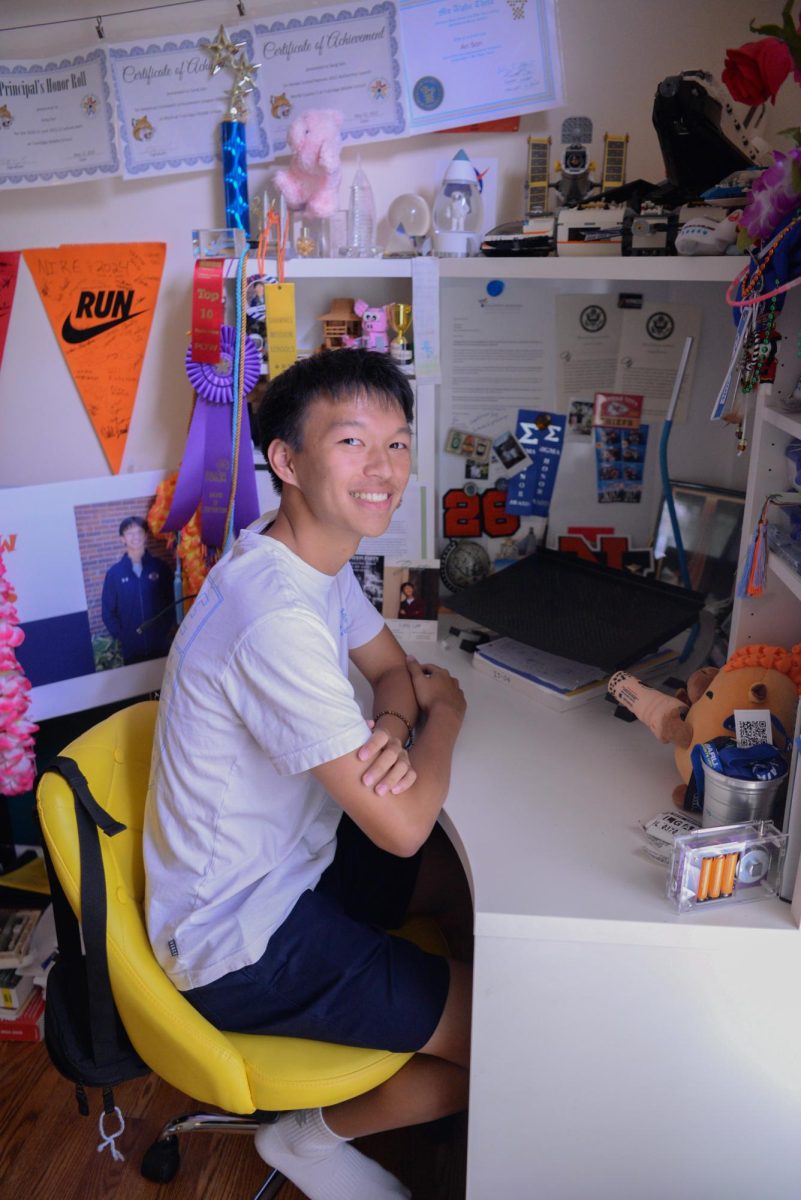
Dash was worried about his return to school — a place where he is a fixture. He loves school. He loves asking people about their days, and talking to everyone in cross country and band – trying to make a joke and making people feel like they belong.
He went for partial days at first, to get reintroduced to the noise and activity of a school day.
At school, Dash was asked daily if he was OK, how he was doing.
“He was surprised at first that everybody knew,” Megan said. “I think he didn’t understand how significant that event was.”
Dash was excused from all the school work he missed during his recovery. But school was a challenge. His first hour was Symphonic band, which meant he either had to skip because of all the noise or spent the hour in a practice room, where the sounds are dimmed, and watch from afar as his friends played.
The danger is the headaches. Any headache could slow down his recovery. He has a cold cap that he places over his head to numb the pain when he has a headache.
Dash also experienced amnesia from the seizures, where he couldn’t remember the right word for something he was talking about, causing him to stutter and get frustrated.
One day during Band, director Brett Eichman announces a drumline event. Eichman told Dash – who plays snare drum – he didn’t have to go. But Dash wanted to. He craved normalcy.
Dash went without letting his mom know. He played stand tunes with his drumline friends and could finally relax a little bit.
No headaches. It felt great.
“I’m gonna be able to go back.” Dash said. “I’m gonna be able to do band.”
Every week, Dash goes to physical therapy to normalize his sense of balance. Dash equates the feeling to being on a rocking boat. He also had a hitch in his eyes as he moved them across. A hitch is where your eyes get stuck for a half second as you move them from side to side. The lack of training and exercise during his time in the hospital and at home caused his muscles to weaken. His physical therapist is a guy named Frank. “He was bald, and he felt like. a fictional character, because he was just so perfect.” Dash said And I would make jokes with my mom about how absolutely adorable he was.”
He and his physical therapist, Frank, do light jogs around the building.
Soon, after Dash goes on his first run is by himself at Mill Creek Park, and with each step, he feels himself slowly being pieced back together.
“It felt like I was treading on ice, I was unsure whether I’d be able to keep going,” Dash said. “I kept going, and the ice held up.”
***
Starting the new school year feels like a reset button for Dash. He has had time to reflect on the empty week in April he can’t remember.
“I cannot believe I’m that fragile,” Dash says. “ small amount of events for it to cause so much damage.”
“I’m back to a place where I’m okay with myself , so I don’t want to change anything that happened.” Dash says.
This accident has made Dash realize how much of an impact this had on the people he loves, and how hard it must have been for them to go through the unknown while he was unconscious and recovering.
“A lot of people were really scared, and that’s the part that I think worries me most,” Dash said. “If I had died or been really badly injured, it would have really badly hurt the people closest to me. Like, my mom, my brother, Gabriella. It would be a really big weight on all of those people’s lives.”

He’s gotten a fresh start and plans to go the whole year without missing any events. Dash has rejoined cross country and is attempting to run closer and closer to his old pace as the weeks go by. As he is entering his junior cross country season, he doesn’t know if he will keep his varsity spot.
His friends sometimes still tiptoe around the injury, making sure that he is okay, always worried they will cause another injury.
“He does the same dumb jokes with me all the time,” Milo Langford said. “He’s still got a lot of energy in him, bouncing off the walls.”
“It was hard for Dash to be confused and scared,” Meghan said. “Doctors said they didn’t know how long his recovery would take.”
Turns out, less than 6 months.
“It was, boom, done,” Meghan said. “He’s recovered so fast. It was wild.”